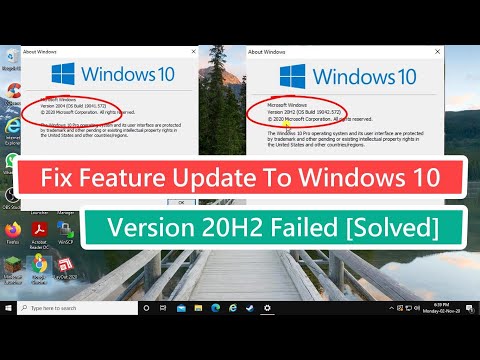
Microsoft has releases feature updates to Windows 10 version 20H2 to end-users. The latest major update for windows 10 comes with a redesigned start menu with theme-aware tiles that adjust their color scheme according to the user's chosen theme. A new more touch-friendly taskbar, ability to adjust the refresh rate for a display and more. Well, all compatible devices get a notification to download Windows 10 version 20H2. And when you are ready and hit the download button Windows 10 20H2 update download and install on your device. That means you have more control over windows 10 feature updates.
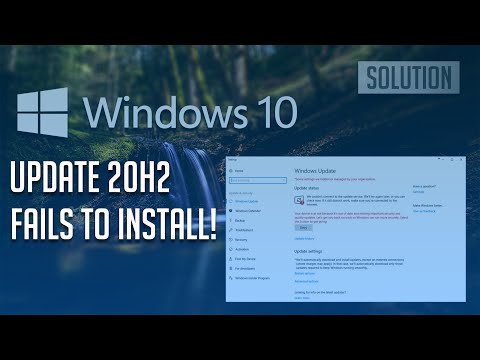
But unfortunately, some users are experiencing issues where feature update to Windows 10 version 20H2 failed to install Apart from this, the windows 10 20H2 update stuck for some users. Recently, Microsoft released the feature Windows 10 version 20H2, also known as the "October 2020 Update" for everyone. This is a huge update that includes a number of new features, security improvements, and various bug fixes. The latest feature update version 20H2 offered to all compatible devices via windows update.
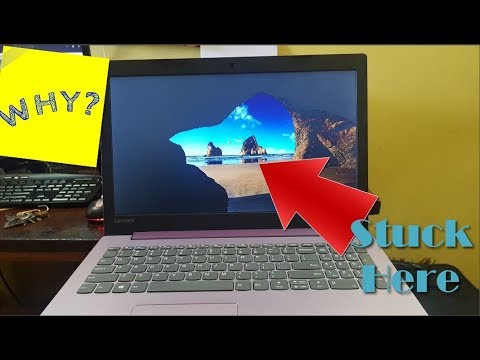
But recently users have experienced Windows 10 October 2020 Update failed to install. Usually, the system reboots without the upgrade. Some users said that the update gets stuck at 50% or 75% completion and then restarts abruptly. This creates an unfavorable experience for end-users as it directly affects their work.
Usually, upgrading from an older release available in a previous year requires full reinstallation, and this process can cause a lot of unexpected problems. A simple way to fix the feature update to windows 10 version 20H2 not installing error is to run Windows Update Troubleshooter. This Windows built-in utility can determine/restart the Windows Update services and delete all the unwanted cached files. Then the error can be fixed during the process. It was just yesterday that I copied over 200-GB of a users files to a fresh install of Windows on a Dell tower. The re-install was required as the same tower had just updated itself to the latest feature update and was no longer bootable with only blue screens showing up at boot, as described in the article.

After the clean install and a reboot, suddenly there were tens of thousands of file attribute errors that were automatically repaired by chkdsk at the next boot. Fortunately, the computer was still usable after the scan. According to Microsoft, the best and short answer is "Yes," the October 2020 Update is stable enough for installation. However, the company is currently limiting the availability, which indicates that the feature update still not fully compatible with many hardware configurations.

Also, at the health dashboard website, the software giant has revealed some problems during the rollout. For example, as part of the known issues, there are some audio driver problems. An issue that causes the loss of system and user certificates when upgrading using the Media Creation Tool, Update Assistant, or ISO file.

However, the problems are not as serious as we've seen with previous releases. I've found this to be due to the feature update checking for critical updates in the background, pre-installation. If I use the media creation tool and the '/dynamicupdate disable' switch it flies through the install. I'm having to build an app in SCCM now to deploy 20H2 as you cannot manipulate this setting via SCCM as a software update, so far as I can tell.
This was especially prevalent for us as we have a group policy in place for dynamic updates throttling comms to Microsoft for updates to 10kbps. For some reason this update check falls outside of config manager and can go directly to Microsoft. Once a new version of the operating system releases, you'll receive a notification in the Windows Update settings letting you know if the update is ready on your device. Based on the prior feature release processes, for example, I know that at the office I will need to deal with repairing PDF printers that will be impacted by the feature update. I use various software products from Intuit, and I have to use the PDF repair tool to fix up my QuickBooks after the feature update process. I also check that backup software and other applications that I have installed on my standalone computers and workstations are happy after the feature update.

There is also Long-Term Servicing Channel Windows. It is a separate version that only receives Quality Updates and not Feature Updates. For more information, refer to this article. Defer The term Microsoft use to delay the checking for and installation of Windows updates.

The amount of time one can defer updates for depends on the version of Windows 10 the device is running. Deferring an update does not change its frequency. Updates will not show up in patch scans if they have been deferred until the deferral time has passed. If three updates are released in a month, users will receive three update notifications but they will do so once their device's deferral period has expired. Patch A dated term used to refer to a Windows update. While you're here, all Windows 10 users might want to click Choose how updates are delivered and ensure that Updates from more than one place is either off or set to PCs on my local network.
I have been dealing with this problem for years. My home office Windows network sharing has always been intermittently reliable with some devices showing up and others not showing. I almost never know what changed between times working and not working times. From my perspective, MS shared networking is pretty much a black box. I've literally tried everything mentioned in this blog in the past years and again recently.
This time, I was really stuck with absolutely no luck for a few weeks. By chance, I was looking at my 3 month old Comcast XB7 wireless router. I was surprised to see that even though all of my wireless devices were working perfectly, the Comcast router said they were all offline. To be clear, sharing was working in the past after installing the XB7 so I didn't really expect the issues to be related.

After spending an hour with Comcast tech support, we completely reset my router and WiFi connection. Immediately, all my active devices showed up as online on the router and MS Internet Explorer showed all of my active devices with sharing working. Using the enablement package approach significantly reduces the number of problems you may see using an in-place upgrade or clean installation. However, it does not resolve the problems with the feature update.
Although the new operating system does not seem to have major issues thus far, you may still encounter isolated problems with the new changes. Now again open Windows update and check for updates. Check if there is no more problem installing windows updates.
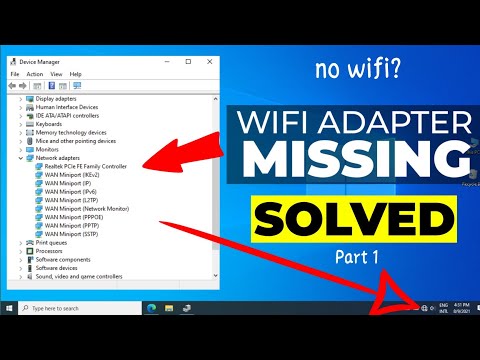
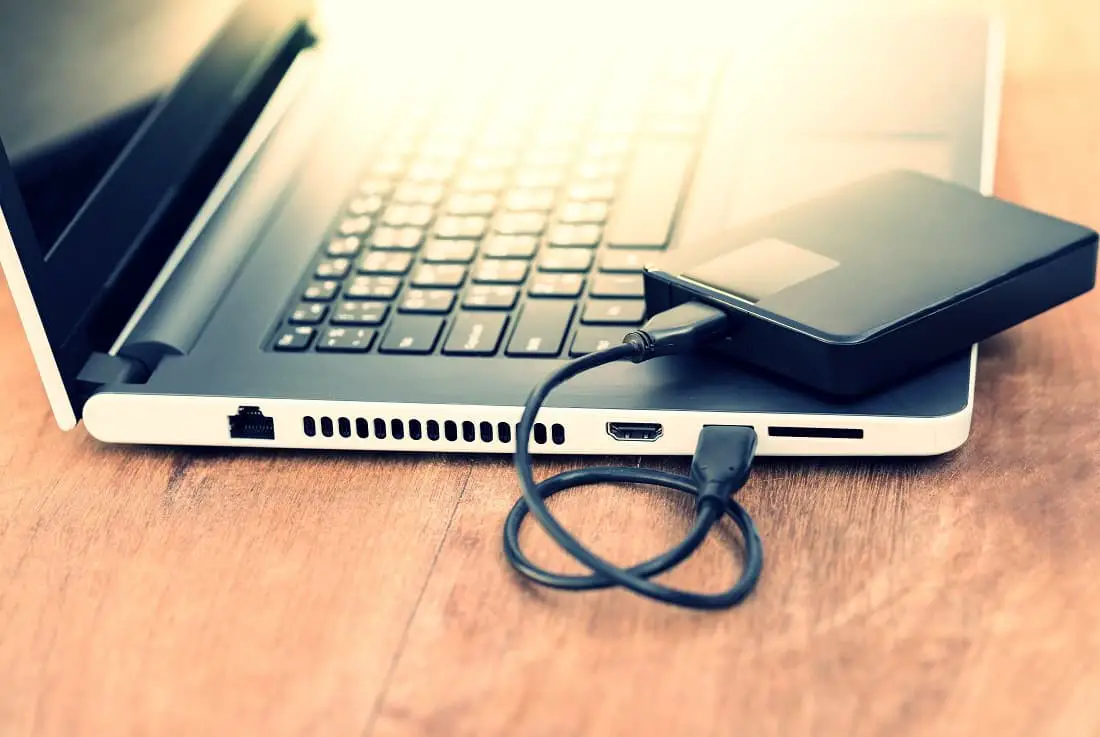
Sometimes after a full operating system update, the PC gets reset and cannot instantly detect outer hardware such as a USB or a wireless mouse. If the USB hardware is still attached to the computer after the update, it may prompt the PC to cause some graphics issues resulting in the black screen. It is wise to unplug all the USB equipment once you see the blank display and restart the computer.

You are free to replug the external devices once the screen gets fixed. Since this is still a feature update based on the May 2020 Update , it will be offered as a cumulative update for devices already using version 2004, 20H2, or 21H1. The upgrade will require complete reinstallation on laptops and desktops running version or older. The only caveat is that the new update will roll out slowly, which means that initially, not every computer will be able to install it. When it comes to Windows 11, there don't appear to be huge changes to updates. Yes, it is moving feature releases to once a year.
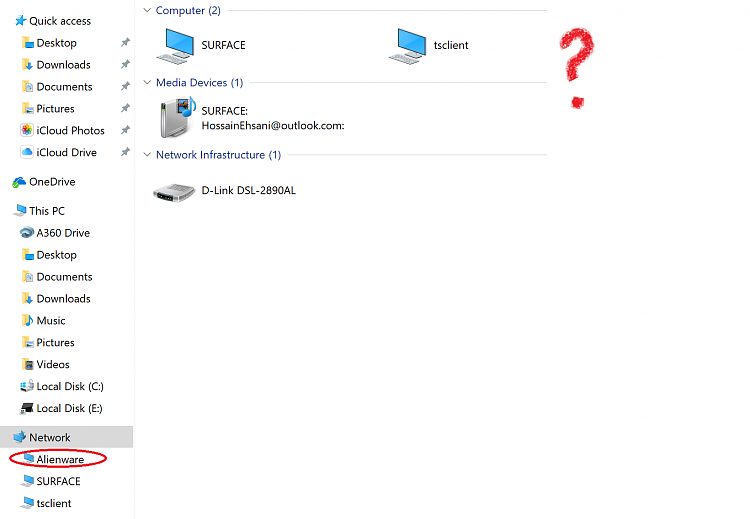
Yes, it's allowing Home and consumer users to have a 24-month support window for each feature release — a big win for Home users. Also, make sure you've opted to keep the personal files and apps and click Install to keep your data, apps, and most of your settings untouched. Now, when you hit install, it should start installing the most up-to-date version of the operating system. I have a Windows 7 Pro desktop, a Windows 10 desktop, and a Windows 10 Pro laptop. After changing all of the settings as recommended and rebooting, I was able to see all of the computers from all of the other computers. But the laptop keeps randomly disappearing from the other two, and the other two keep losing visibility of the laptop.
Today, all of them were visible and I could share files fine. Then I closed my laptop, (sleep mode.) When I opened the laptop up again, I could no longer see the Windows 7 computer, but I could still see the other Windows 10 PC. I restarted the laptop, and then I could see the Win 7 PC again. Is there a setting that I'm missing so that I don't have to reboot every time I want to see that Win 7 PC?

Without these helpful free tools, IT work would be a hell for me. Also, the answer to whether you should install this version depends on the release already installed on your computer. If the device is already running version 2004, you can install version 20H2 with minimal to no risks.

The reason is that both versions of the operating system share the same core file system. As a result, the new features have already been deployed in an inactive state. The system only needs a small "enablement package"to activate the new version with a quick reboot that doesn't require reinstallation. However, since you are now in control of upgrading new feature updates, the question remains whether you should install it now or wait some additional time. The reason is that it's a known fact that during the early days, devices have higher chances of running into problems. If a service related to Windows Update is experiencing issues, has been turned off, or is set to incorrect settings, it's possible that it's the cause of your errors.
Luckily, you can simply fix this by executing some commands which reset your services that work with delivering updates. Although you will have the option to upgrade manually, computers nearing the end of service will eventually receive version 21H2 automatically through Windows Update. However, this does not happen immediately after the update. Usually, it takes weeks or months before Microsoft begins the rollout of a feature update automatically.
As usual, the deployment will begin with computers featuring newer hardware, and over time, the update will expand to other devices. However, many other factors may affect availability. For example, it could be a problem with hardware or peripherals, incompatible drivers, apps, security software (such as third-party antivirus), and the device's location.
However, unlike previous releases, the version will be offered differently. For example, if the device is compatible with Windows 11, a notification to install the most advanced version will be offered through Windows Update. If you are comfortable using Windows 10, you can choose the "Stay on Windows 10 for now" option, at which point version 21H2 will be offered automatically. Also, you can use the official Windows 10 media creation tool to upgrade October 2020 update without any errors. If you are looking for a fresh installation here how to download Windows 10 20H2 ISO direct from the Microsoft server.
Errors and bug with the operating system can result in the feature update to Windows 10 version 20H2 failed to install issue too. Both of them are administrative-level tools that can scan the system for errors and then fix them. I always use the release of a new feature update to be the sign that I need to ensure that all of my main computers are on the prior release. I prefer to stay one release behind, as it typically provides me with a stable system with full Microsoft support, and I'm able to identify what issues I may face. So I'm using this time to ensure I have a copy of Windows 10 21H1, which was released in May, saved on a flash drive or on a storage location on a hard drive.
Upgrade Windows 10 to Windows 11, A complete step by step guide with proper upgrade image sequence is available on this page. As Microsoft has released Windows 11 on 24th June 2021, Windows 10 and Windows 7 users want to upgrade their system with Windows 11. As of now, Windows 11 is a free upgrade and everyone can upgrade from Windows 10 to Windows 11 for free. You should have some basic knowledge while upgrading your windows. In this article, we are going to provide you details about How to Upgrade Windows 10 to Win11.

Before installing any software, driver, or OS update, run a disc scan (sfc/ scannow, chkdsk /r, etc) to ensure integrety of the media before writing new critical files to it. It takes less time that it took anyone to read and post here. Why in the world would you blame Microsoft for something you had control over?

Microsoft certainly works hard, as do we beta testers that work unpaid to work through all of the possible combinations of hardware/software that might cause an issue. It's entirely too complex to say that anything in any combination of configurations is going to work without causing possible data loss. Disable it by searching for Power Options in the Start Menu and running the matching Control Panel applet, then in the left-hand pane click Choose what the power buttons do. Click Change settings that are currently unavailable, scroll down and un-tick Turn on fast start-up, then click Save changes. This should prevent a very slow start on affected PCs. Some users report that if they subsequently reboot, re-trace their steps and re-enable fast start-up the problem remains cured.

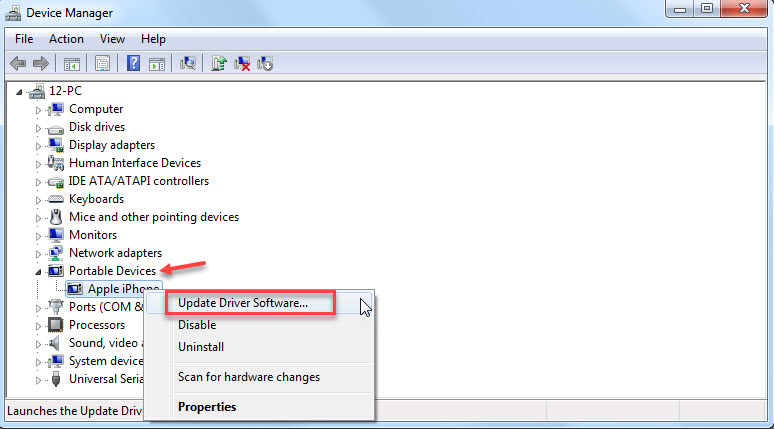
Windows 10 20H2 Not Showing Check the software distribution folder for any buggy updates prevent windows updates to install. 3) Click the Update button next to the driver you want to update to automatically download the correct version of this driver, then you can manually install it . The installation process will also depend on the current setup. For example, if the computer has version 2004, 20H2, or 21H1, only an enablement package is required to activate the new changes. This means that the installation will be similar to the one when applying a monthly update. On the other hand, if the computer has an older version, the experience will require complete reinstallation.
Again sometimes corrupted system files cause windows 10 updates to stuck downloading. Run the system file checker that scans and fix corrupted system files on Windows 10. Once this setup is complete you should see a 'Ready to install' message in the window. The 'Keep personal files and apps' option should be selected automatically, but if it isn't, you can click 'Change what you want to keep' to make your choice. While these group policy settings are reorganized to make more sense, I don't see any major changes.

I view Windows 11 as yet another feature release, one that I will choose and manage just as I do Windows 10. The only difference is that this time I might not be able to roll it out to all of my machines due to hardware mandates. If you don't receive the notification, you shouldn't force to update with the Media Creation Tool, Update Assistant, or ISO file. Windows 10 version 20H2 won't install may because of some compatibility issues. You should ensure that all installed device drivers are updated and compatible with the present Windows version. They include display driver, network driver, and audio sound driver.


